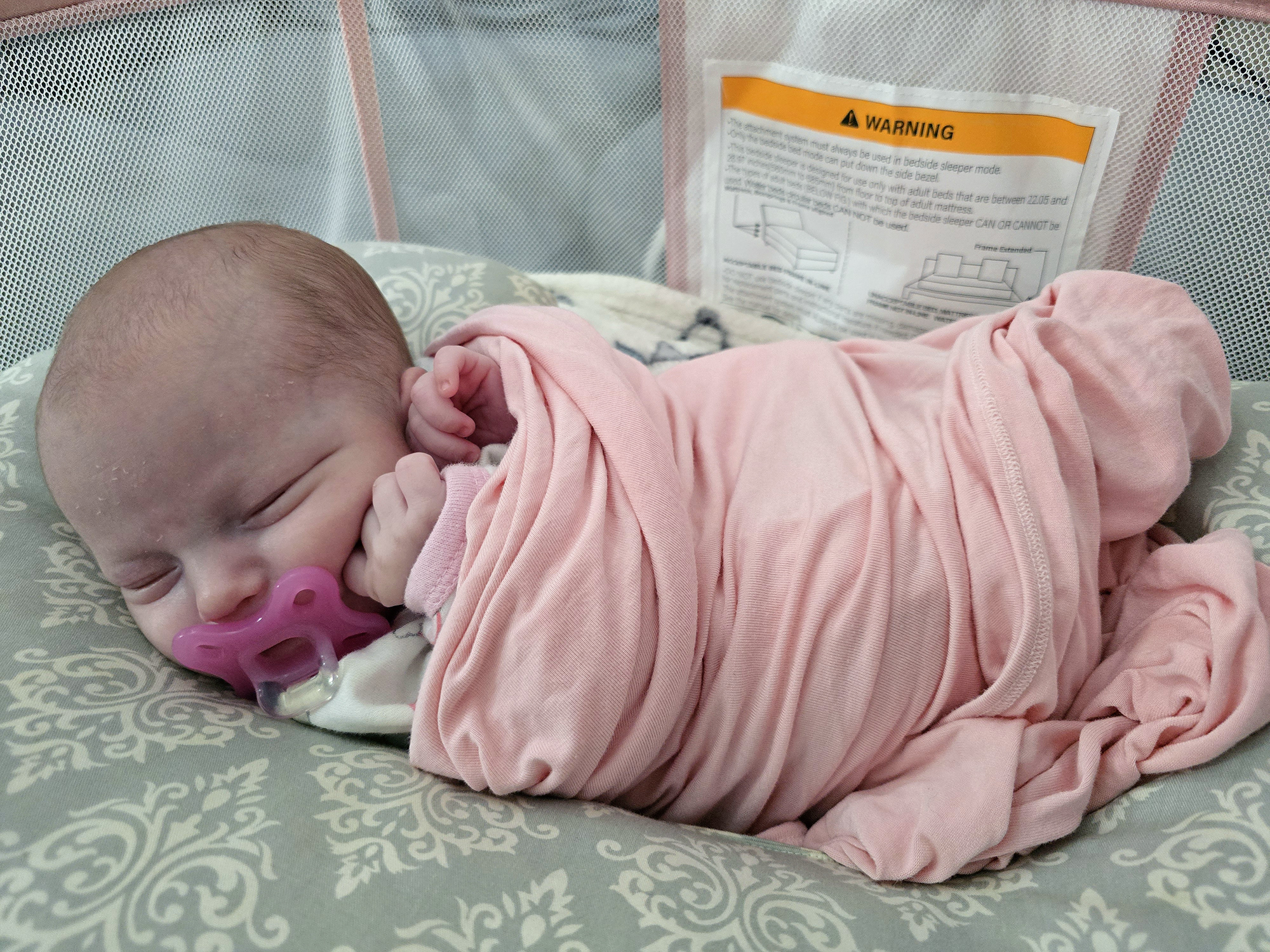
Heather Barr wasn’t a first-time mom, so when she brought her infant daughter, Sophia, to Watford City, North Dakota, in June for the baby’s second-week checkup, she expected it to be a routine visit.
But when Dr. Waco Goodnight placed his stethoscope near the baby’s heart, the pediatrician noticed a murmur that had grown significantly louder than the one he heard at birth.
Dr. Goodnight briefly left the McKenzie Health exam room and returned with a point-of-care ultrasound (POCUS) machine, a handheld device used by providers for immediate assessment.
“He was back within minutes,” Barr says. “I didn’t even have enough time to freak out over what was happening.”
Heather Barr plays with Sophia.
Dr. Goodnight checked the structure of Sophia’s heart and detected no abnormalities, but when he moved it to the baby’s lungs, he noticed some fluid. Knowing that fluid could be an indicator of Ventricular Septal Defect (VSD) — a hole between the heart’s two lower chambers — he snapped several ultrasound images and texted them to pediatric cardiologist Dr. Justin Horner.
Dr. Horner reviewed the pictures, echoed Dr. Goodnight’s concern, and said, “ Yeah, we need to get her in immediately.” Dr. Horner was scheduled to be in the North Dakota city of Minot the next day, so he penciled in Sophia for an echocardiogram between appointments.
Heather and Sophia made the nearly three-hour trip from their home in Fairview, Montana, and the test revealed some concerning news — Sophia had an 8-millimeter hole in her heart that was unlikely to close on its own. The gap would require surgery.
It wasn’t what Barr wanted to hear, but she and her husband, Brad, are thankful that they were able to receive such a quick diagnosis for Sophia.
Since receiving that news, Barr has spent every Wednesday driving Sophia to Bismarck or Watford City, alternating between Dr. Horner conducting echocardiograms to ensure the hole wasn’t growing and Dr. Goodnight performing weight checks and follow-up ultrasounds to monitor the fluid levels around Sophia’s lungs.
On Oct. 20, surgeons at Denver Children’s Hospital performed a VSD repair to patch Sophia’s heart. The surgery successfully closed the hole in her heart. Sophia is on the journey to recovery with the support of her healthcare team and her parents.
Brad Fendrick holds Sophia.
Dr. Goodnight’s POCUS machine was one of one of 215 imaging devices provided to North Dakota facilities through a 2025 grant initiative of $27.4 million from the Helmsley Charitable Trust. Helmsley has made similar grants, which also include money for training, to facilities across Nevada, Minnesota, and Wyoming.
Dr. Goodnight now considers the device a tool as essential as his stethoscope. It’s noninvasive, always accessible, and allows him to quickly catch a potential problem or rule one out, he says.
“And maybe I don’t see anything, but maybe I do, and that could vastly change things,” Dr. Goodnight says.
Barr is so grateful that everything fell into place the day she brought Sophia to Watford City. Dr. Goodnight noticed the louder murmur, the POCUS machine was available for him to further investigate, and Dr. Horner was able to see Sophia the next day.
“Fate was lined up,” she says. “They all knew that she was going to have a heart problem, and they were ready for us.”


